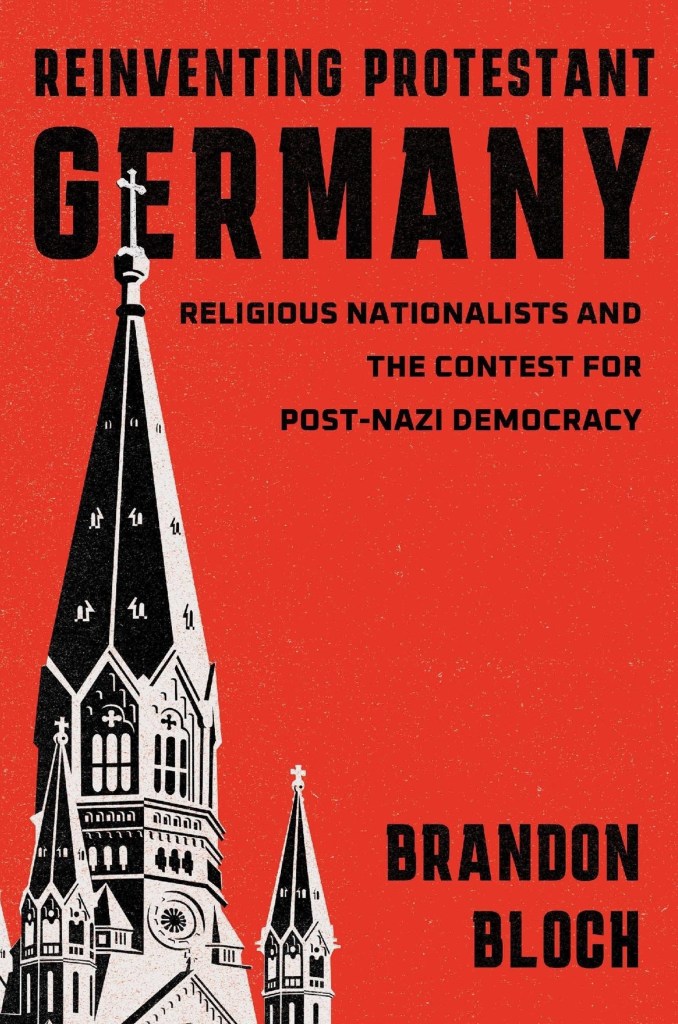
A revealing account of how German Protestant leaders embraced democratic ideals after WWII, while firmly and consequentially refusing to account for their earlier complicity with Nazism.
Germany’s Protestant churches, longtime strongholds of nationalism and militarism, largely backed the Nazi dictatorship that took power in 1933. For many Protestant leaders, pastors, and activists, national and religious revival were one and the same. Even those who opposed the regime tended toward antidemocratic attitudes. By the 1950s, however, Church leaders in West Germany had repositioned themselves as prominent advocates for constitutional democracy and human rights.
Brandon Bloch reveals how this remarkable ideological shift came to pass, following the cohort of theologians, pastors, and lay intellectuals who spearheaded the postwar transformation of their church. Examining the sources and limits of democratic transformation, Reinventing Protestant Germany sheds new light on the development of postwar European politics and the power of national myths.
Purchase from Harvard University Press
Praise
“Brandon Bloch’s carefully argued book illuminates the central role of Protestant pastors and theologians in twentieth-century German politics, from fervent nationalists to apologists for dictatorship, from central figures in the post-1945 peace movement to defenders of democracy. This volume reveals like no other the contradictions and continuities that defined these intellectuals so central to Germany’s turbulent modern history.—Peter C. Caldwell, author of Democracy, Capitalism, and the Welfare State: Debating Social Order in Postwar West Germany, 1949–1989
“How did the German churches reconstitute themselves after the Third Reich, given the often-complicit role they played in the Holocaust? In this superb, detailed examination of the postwar years, Brandon Bloch presents the ambivalence of Protestants toward denazification, democracy, women’s rights, and their own ethical failures under Nazism.”—Susannah Heschel, author of The Aryan Jesus: Christian Theologians and the Bible in Nazi Germany
“Brandon Bloch offers compelling new insights into the ideological transformation of twentieth-century Protestantism, a process as essential to the establishment of West German democracy as it was complex and contradictory. By tracing Protestants’ distinctive regard for the state, postwar denial of support for Nazism, and internal dissension, Bloch expertly elucidates the relationship of Christianity to nationalism in a country where their entanglement facilitated genocide.”—Maria D. Mitchell, author of The Origins of Christian Democracy: Politics and Confession in Modern Germany
“An astonishing story, deeply researched and lucidly argued. Brandon Bloch reveals how a generation of German Protestant pastors and lay intellectuals, steeped in a tradition of illiberal nationalism and unwilling to confront their Church’s complicity with Nazism, nevertheless refashioned themselves as champions of West German democracy after the war. Masterfully reconstructing the legal, ideological, and moral debates that nurtured this transformation, he shows that Protestant contributions have left a complicated legacy for German society today.”—Paul Hanebrink, author of A Specter Haunting Europe: The Myth of Judeo-Bolshevism
 Brandon Bloch